What is the interviewer actually testing?
Interviewers rarely care about personal drama. What they are actually testing is your professional judgment, your capacity to handle friction over technical or operational decisions, and your willingness to commit once a direction is chosen. Here is how to reframe conflict questions to show high ownership, emotional intelligence and professional maturity.
Why describe a technical disagreement instead of a personal clash?
The strongest responses do not center on personal friction. They focus on professional disagreements over how a goal should be achieved. When you frame the conflict around competing methods, technical trade-offs or strategic priorities, you show that your primary focus is project success rather than ego.
An effective response demonstrates three specific behaviors:
- Active listening: you took concrete steps to understand the other person's perspective and underlying concerns instead of simply pushing your own agenda.
- Receptivity to feedback: you evaluated their points objectively and incorporated strong suggestions into the plan.
- Focus on outcomes: you prioritised finding the best solution for the business rather than winning an argument.
Showing that you can take feedback, adjust your assumptions and integrate superior ideas signals that you are collaborative and easy to work with.
What does disagree and commit look like in an answer?
To turn a good answer into an exceptional one, address what happens when an agreement cannot be reached. Picture a situation where you and a colleague both present valid, well-reasoned approaches to a problem. The debate stalls, and a manager or team lead has to step in as the tiebreaker. The lead chooses your colleague's proposal.
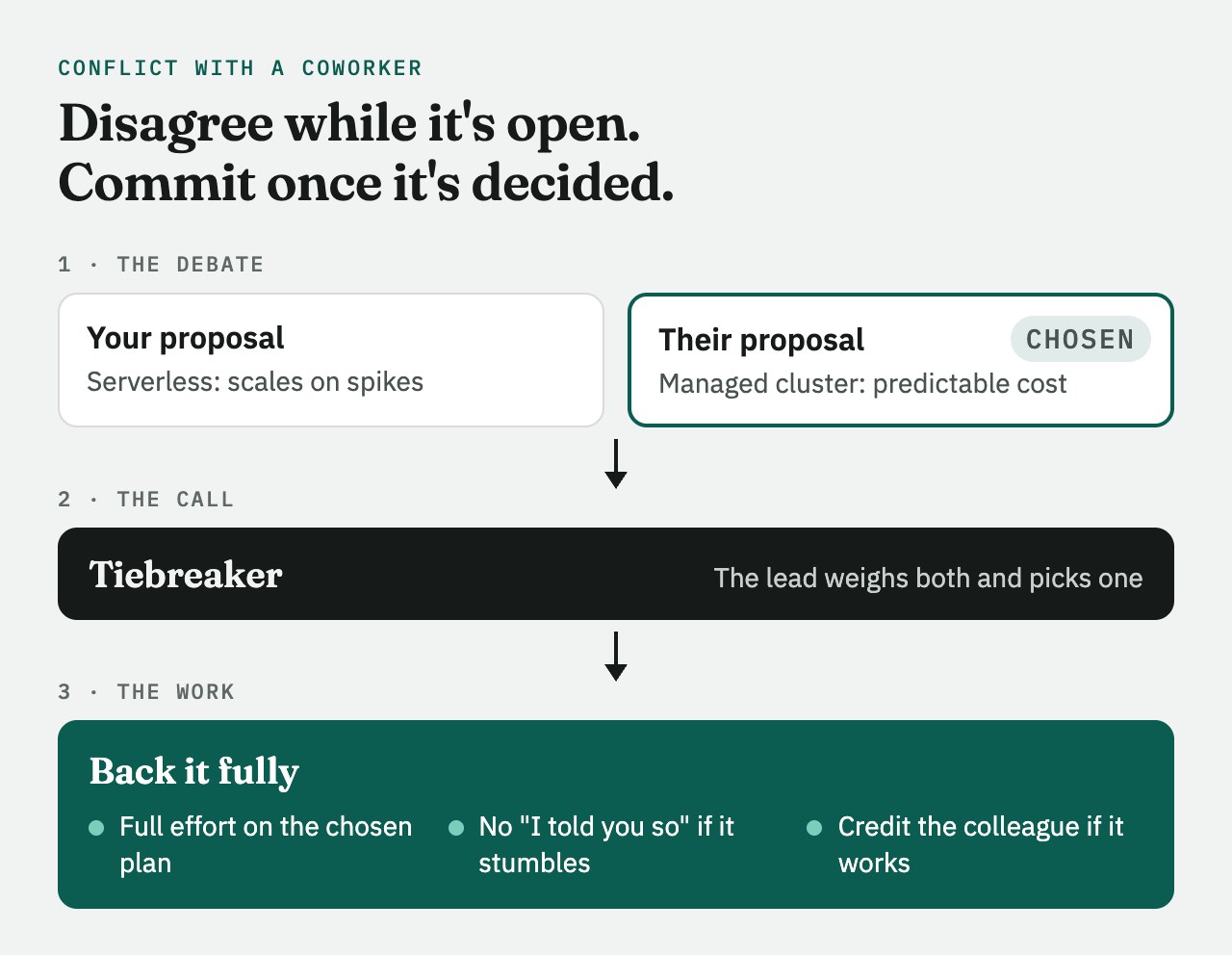
How you behave after that decision is made defines your maturity as an engineer or manager. A high-performing candidate demonstrates full alignment after the call:
- Uncompromised execution: once a decision is made, you back it 100%. You do not passively resist, withhold effort or quietly wait for the project to stumble so you can prove a point.
- No "I told you so": if the chosen path hits roadblocks or fails, you do not use it to score points or prove you were right. You focus entirely on troubleshooting and fixing the issue.
- Shared success: if the approach succeeds, you freely give credit to the colleague who proposed it, without bitterness.
Demonstrating that you can disagree vigorously during the decision phase, yet commit entirely during execution, proves you are focused on team outcomes over personal validation.
How do you structure the answer with the STAR method?
Use the STAR method (Situation, Task, Action, Result) to keep your story tight, grounded in specifics and focused on business impact. Each part has one job:
- Situation: set the background quickly. Define the specific operational or technical crossroads without assigning blame.
- Task: explain what needed to be accomplished and where the fundamental disagreement lay.
- Action: detail the steps you took to understand their viewpoint, evaluate options, involve stakeholders if necessary and arrive at a resolution.
- Result: quantify the outcome. Share the metrics, delivery timelines or operational improvements achieved, and show your full commitment to the final decision.
What does a strong example answer sound like?
Here is an example answer using the STAR method. The project, people and numbers are made up for this post, so swap in your own. Notice that the decision goes against the person answering, and the answer is stronger for it.
Situation: During a major architectural update for our primary data pipeline, a senior engineer and I disagreed on how to handle incoming event processing. I proposed migrating to an event-driven serverless model to handle peak spikes automatically. My colleague advocated expanding our existing managed cluster services to keep baseline costs predictable and operational overhead low for the current team.
Task: We needed to finalize the architecture design within two weeks to keep our quarterly launch timeline on track, without blowing our infrastructure budget or creating an unmanageable maintenance burden.
Action: I scheduled a targeted working session to walk through our respective designs. Instead of debating preferences, I focused on understanding his core concern, which was the learning curve and monitoring overhead for the team. I benchmarked cold-start latencies and drafted a cost-projection model for both approaches across three traffic scenarios.
Our benchmark data showed valid arguments on both sides. Mine offered better scalability during unpredictable spikes, while his offered predictable monthly costs and faster initial deployment. We presented the findings to our engineering director to act as a tiebreaker.
The director decided to go with the managed cluster approach to prioritize speed to market for the upcoming quarter. Once the decision was final, I fully backed the direction. I volunteered to lead the Terraform module setup for the cluster deployment and helped document the scaling runbooks so the launch went smoothly.
Result: We delivered the pipeline migration two days ahead of schedule, handling a 40% increase in daily event throughput with zero downtime during the initial rollout. By setting aside my initial preference and committing fully to the chosen architecture, we kept project momentum intact and delivered a reliable system without friction.
Where can you practise your answer?
There are more example answers on our page for the conflict with a coworker question, including the follow-ups that tend to come next. When your own story is ready, say it out loud in Prept's Mock room and get feedback on your answer before the real interview.
Happy job hunting.